

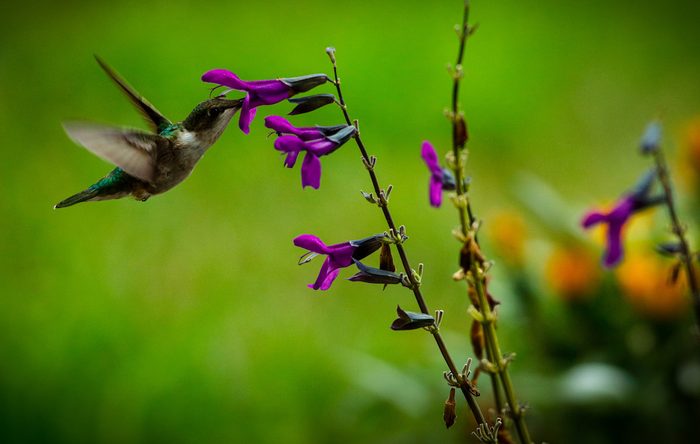
From window boxes to hanging baskets, container gardening is well known as a versatile way to add a bit of drama and color to any space—but it can be functional, too! Pack even more punch in your compact combinations by cultivating a nourishing hummingbird buffet with these tried-and-true container garden ideas.
Photos and container planting plans from Proven Winners
On This Page
How to Choose a Container
To anchor everything, you need the right container. You’ll certainly have plenty to choose from. Just go to the garden center, and chances are you’ll find rows and rows of them in every size, shape and color imaginable. Before you even start looking at plants, find a container that inspires you. A short, stocky container would be just the thing for a small conifer. A bold turquoise container would be the perfect backdrop for various shades of pink. A big, tall container is a nice option for trailing plants.
A good pot or other planter can be expensive, but go ahead and splurge a little if you find one you really like. Chances are you’ll have it for years. Oh, and remember that containers are like shoes—they’re better when you buy them in pairs!
One more thing to consider: make sure your container has drainage holes so that your soil doesn’t become waterlogged, which could lead to root rot.
Get more tips for watering container gardens.
Design Containers Like a Pro
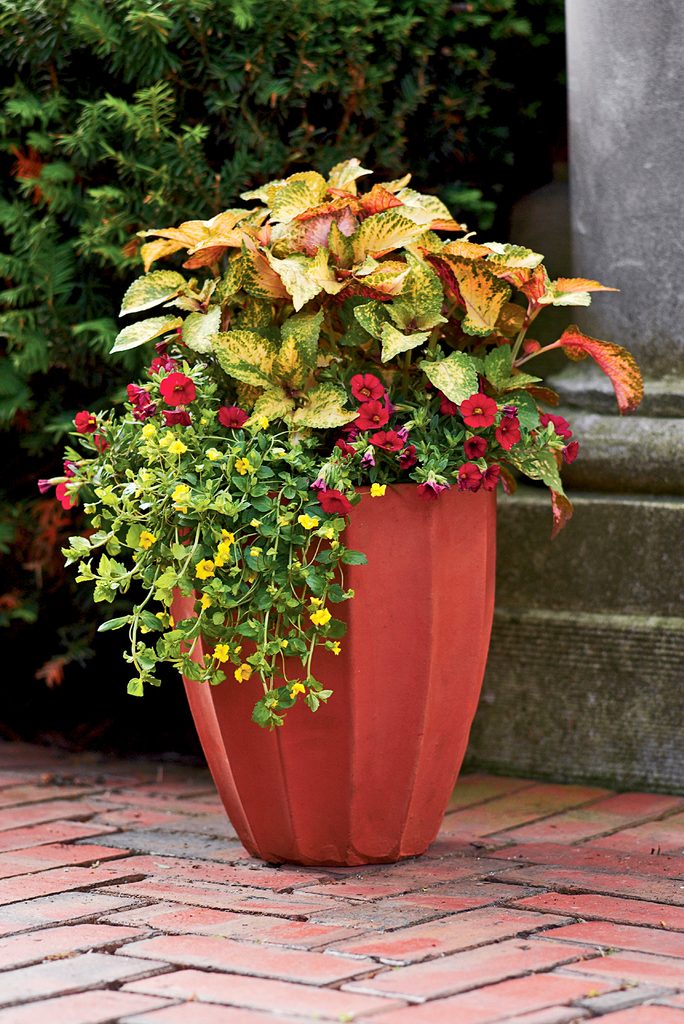
One common way to create a visually appealing container is by using the “thriller, filler, spiller” technique.
- Thrillers add the wow factor with their height. Plant according to how the pot will be viewed. If it will be viewed from all sides, place it in the middle. Or if viewed from the front only, place it in the back.
- Fillers create dense volume by packing the pot with their mounded or rounded natures. These should be placed around or in front of the thriller.
- Spillers bring dramatic depth and texture as they overflow out of the pot. These are trailing plants that should be planted near the edge of the planter.
Learn how to grow a container garden for herbs.
Add Drama With Tall Plants
One of the easiest ways to make an impact with a container is tall plants. You can find some colorful annuals, but don’t overlook perennials. Just because you’re growing in a container doesn’t mean you have to dump the plants out each year. Offer the perennials good protection in a weatherproof pot over the winter, and you’ll have a jump on next year.
Include Trailing Plants
Trailing plants are a must-have for hanging baskets, but they’re a showstopper for other container garden ideas, too. Garden centers often have a whole section of trailing plants. Use blooms like trailing begonias, petunias and geraniums, or try foliage plants like sweet potato vine and licorice vine. You’ll probably want to stick to a single type of trailing plant per container, but it can be fun to mix in a couple of varieties within a single family.
Check out the best dwarf flowering shrubs for containers.
Choose Bold Colors
You don’t necessarily want to pair bright red flowers with a bright red container. But with a little bit of planning, you can use color to your advantage. It starts with your pot of choice. How colorful is it? If you love bright orange, yellow or blue pots, what’ll work well as accents?
Another option is to choose a more subdued, neutral pot that maybe has an interesting shape or lines. Then use plants to make an impact. One advantage to this is that you can change the plants from one year to the next. If you have a brown or terra-cotta pot, you could have a red, white and blue theme one year and a yellow theme the next.
Don’t Forget About Presentation
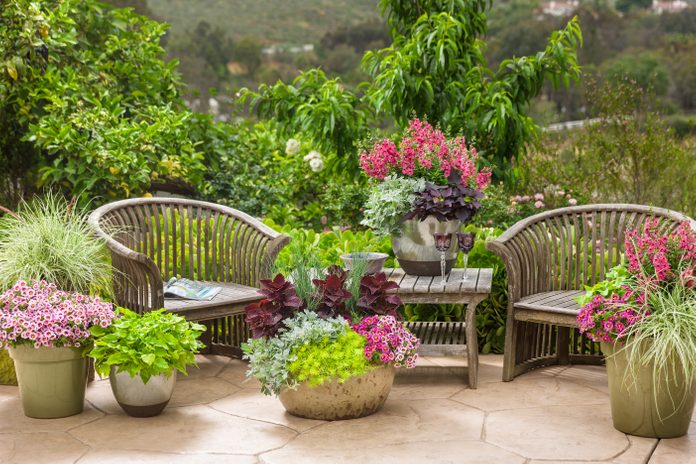
So you have your height and your trailing plants. You’ve chosen an attractive container. And you’ve used color to your advantage. Now you just need to make sure that everything works together.
Where will your container live? What do you have planted around it? If it’s in a solitary location, is it big enough to fill up the space? The planning and placement of your container are the deciding factors in its success. Give it an outstanding display, and all your hard work will be worthwhile.
Now that you know the basics, use these container garden ideas from Proven Winners as inspiration.
Container Garden Ideas to Attract Hummingbirds
Dancing With the Moon
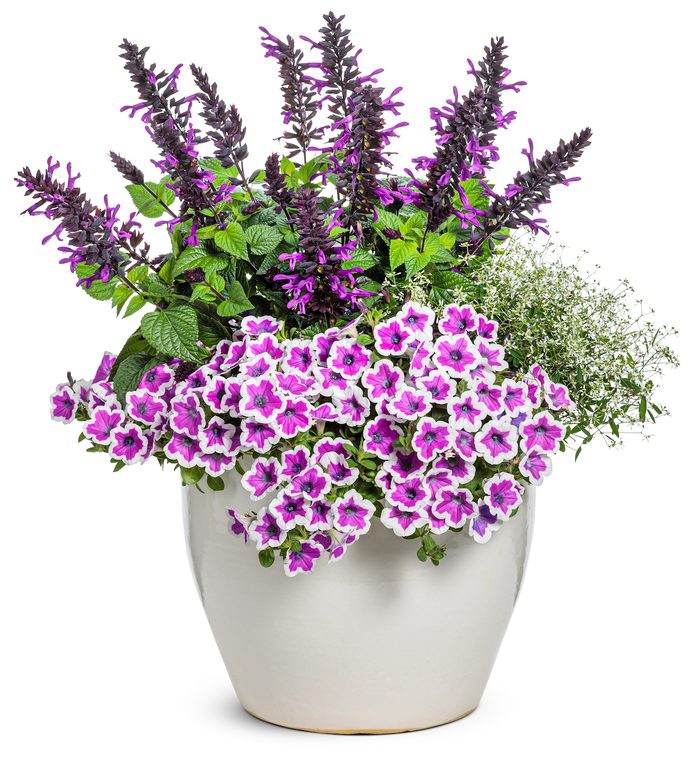
- Exposure: Part sun to sun
- Seasons: Spring, summer, fall
- Container size: 12 inches
- Rockin’ Deep Purple
Salvia hybrid
Thriller, Quantity: 1 - Diamond Frost
Euphorbia hybrid
Filler, Quantity: 1 - Supertunia Hoopla Vivid Orchid
Petunia hybrid
Spiller, Quantity: 1
Bouffant
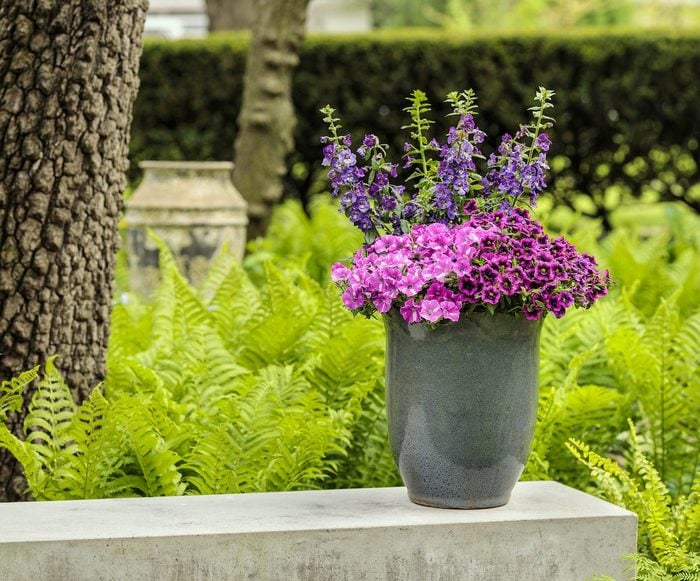
- Exposure: Part sun to sun
- Seasons: Spring, summer, fall
- Container size: 14 inches
- Angelface Blue Summer Snapdragon
Angelonia hybrid
Thriller, Quantity: 1 - Superbells Blackcurrant Punch
Calibrachoa hybrid
Filler, Quantity: 1 - Supertunia Raspberry Rush
Petunia hybrid
Spiller, Quantity: 1
Over the Falls
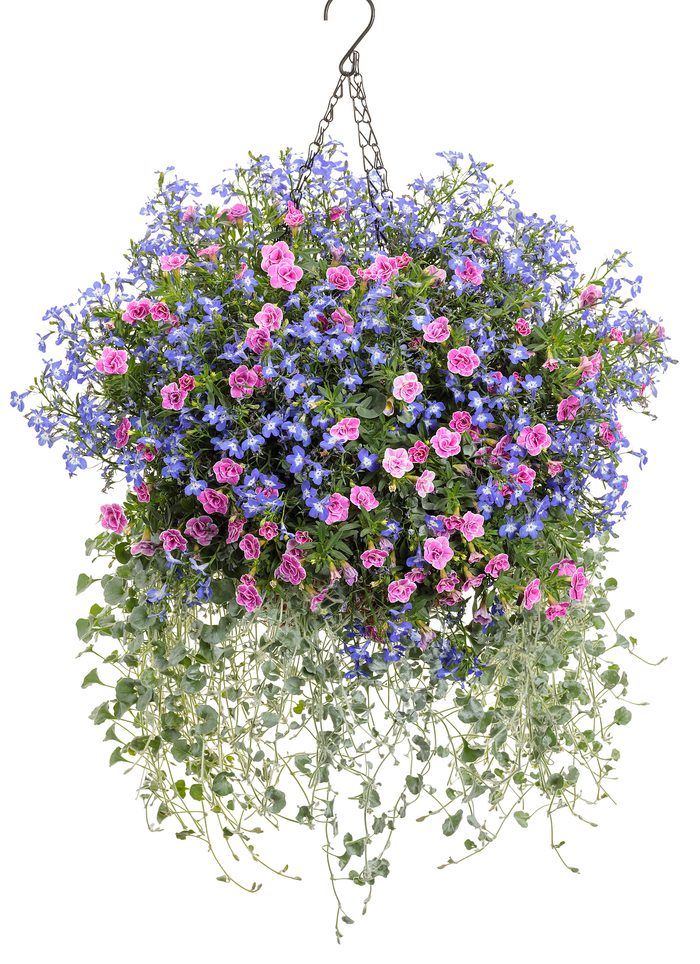
- Exposure: Part sun to sun
- Seasons: Spring, summer, fall
- Container size: 12 inches
- Laguna Compact Blue with Eye
Lobelia erinus
Filler, Quantity: 2 - Superbells Doublette Love Swept
- Double Calibrachoa Calibrachoa hybrid
Filler, Quantity: 2 - Silver Falls
Dichondra argentea
Spiller, Quantity: 1
Hot for Me
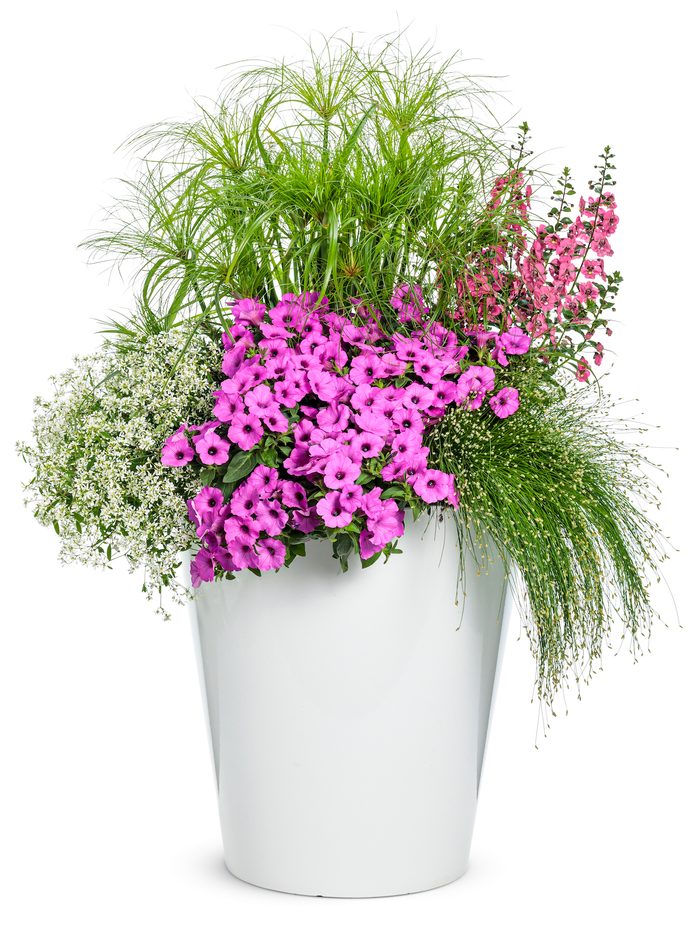
- Exposure: Part sun to sun
- Seasons: Spring, summer, fall
- Container size: 14 inches
- Angelface Perfectly Pink Summer Snapdragon
Angelonia hybrid
Quantity: 1 - Graceful Grasses Prince Tut Dwarf Egyptian Papyrus
Cyperus papyrus
Thriller, Quantity: 1 - Diamond Snow
Euphorbia hybrid
Thriller, Quantity: 1 - Graceful Grasses Fiber Optic Grass
Isolepsis (Scirpus) cernua
Filler, Quantity: 1 - Supertunia Vista Jazzberry
Petunia hybrid
Filler, Quantity: 1
Parisian Nights
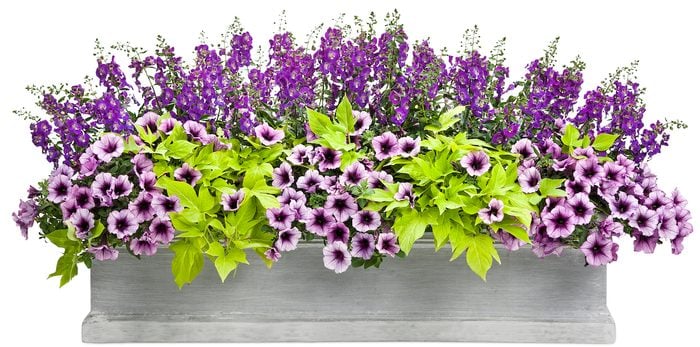
- Exposure: Sun
- Season: Summer
- Container size: 36 inches
- Angelface Blue Summer Snapdragon
Angelonia hybrid
Thriller, Quantity: 3 - Supertunia Bordeaux
Petunia hybrid
Spiller, Quantity: 3 - Sweet Caroline Light Green Sweet Potato Vine
Ipomoea batatas
Spiller, Quantity: 2
Why Trust Us
For nearly 30 years, Birds & Blooms, a Trusted Media Brand, has been inspiring readers to have a lifelong love of birding, gardening and nature. We are the #1 bird and garden magazine in North America and a trusted online resource for over 15 million outdoor enthusiasts annually. Our library of thousands of informative articles and how-tos has been written by trusted journalists and fact-checked by bird and garden experts for accuracy. In addition to our staff of experienced gardeners and bird-watchers, we hire individuals who have years of education and hands-on experience with birding, bird feeding, gardening, butterflies, bugs and more. Learn more about Birds & Blooms, our field editor program, and our submission guidelines.
On This Page
Native Butterfly Weed Care
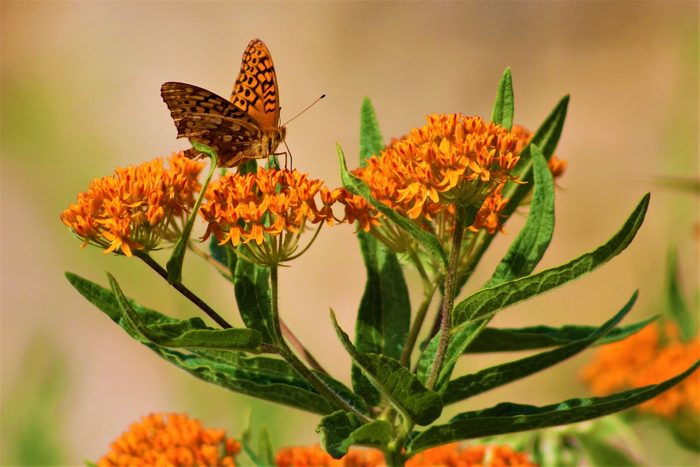
- Common name: Butterfly weed
- Scientific name: Asclepias tuberosa
- Growing zones: 3 to 9
- Light needs: Full sun
- Soil: Well-draining
- Size: Two to three feet tall and equally as wide
Check out the ultimate guide to growing milkweed plants for monarch butterflies.
Is Butterfly Weed a Type of Milkweed?
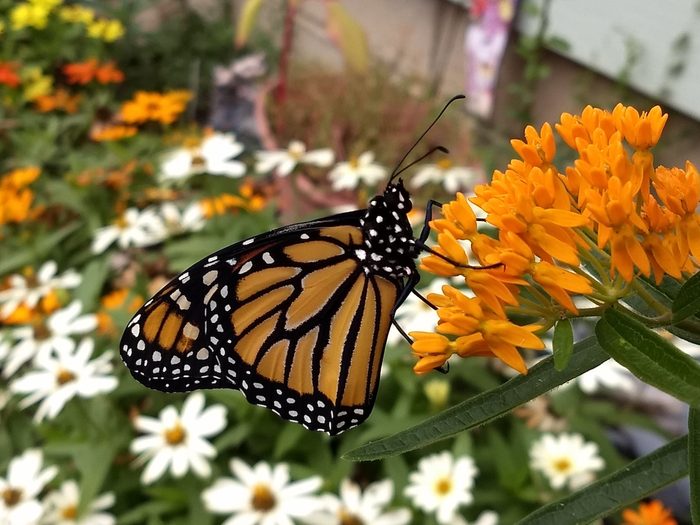
Butterfly weed is part of the milkweed family. The Monarch Joint Venture recommends this native milkweed for gardeners in the northeast, midwest and southeast regions.
“I’ve read that milkweed is the only host plant for monarch caterpillars. I don’t have milkweed, but I do have butterfly weed. I came upon about a dozen monarch caterpillars munching on the leaves. Is this unusual?” asks Birds & Blooms reader Charlotte Hense of East Troy, Wisconsin.
Gardening expert Melinda Myers says, “Monarch caterpillars will dine on all species of milkweeds, including butterfly weed. This milkweed species thrives in full sun and well-draining soil. It is also less aggressive than common milkweed, making it a good choice for smaller landscapes. Other milkweeds such as red, swamp, showy, whorled and green are also good choices. The Xerces Society has helpful guides for selecting the best milkweed plants for your region.
Benefits of Growing Butterfly Weed
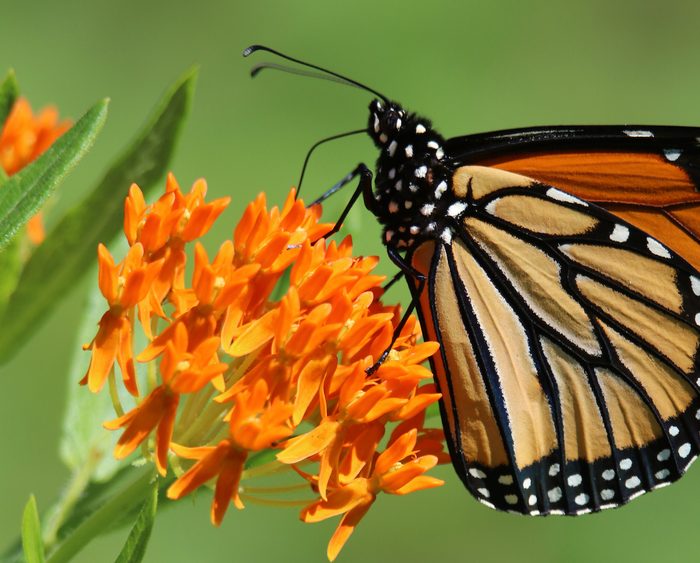
It’s easy to see why gardeners would choose to add this plant to their yards. This flowering perennial is a magnet for pollinators. Its gorgeous orange blooms persist through the summer, and it’s a favorite for cut flower gardens or dried flower arrangements. When planted in a meadow setting, it will naturalize and come back year after year, however it does not spread aggressively.
It’s a relatively low-maintenance plant as well, and it grows in poor, dry soil and even on slopes. Handling extreme conditions with ease, it’s drought tolerant as well as cold hardy. It’s usually deer-resistant in addition to being disease-free. It doesn’t produce as much milk sap as other milkweeds, which makes it ideal for gardeners with sensitive skin and pets.
Learn how to save and plant milkweed seeds from pods.
Does Butterfly Weed Attract Pollinators?
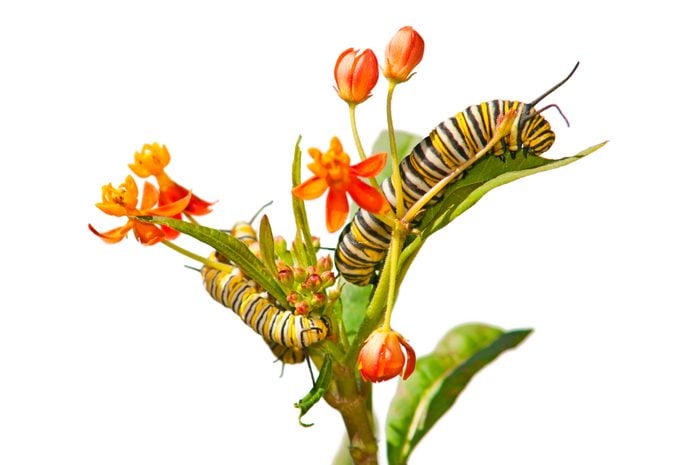
Increased pollinator presence is likely the biggest benefit of adding this plant to one’s garden. Native butterfly weed brings in plenty of good bugs! As a member of the butterfly milkweed family, it’s a monarch butterfly host plant. It’ll draw in black swallowtail butterflies, too, as well as other pollinators such as bees.
Learn how to get rid of aphids on milkweed plants.
Butterfly Weed Cultivars to Grow
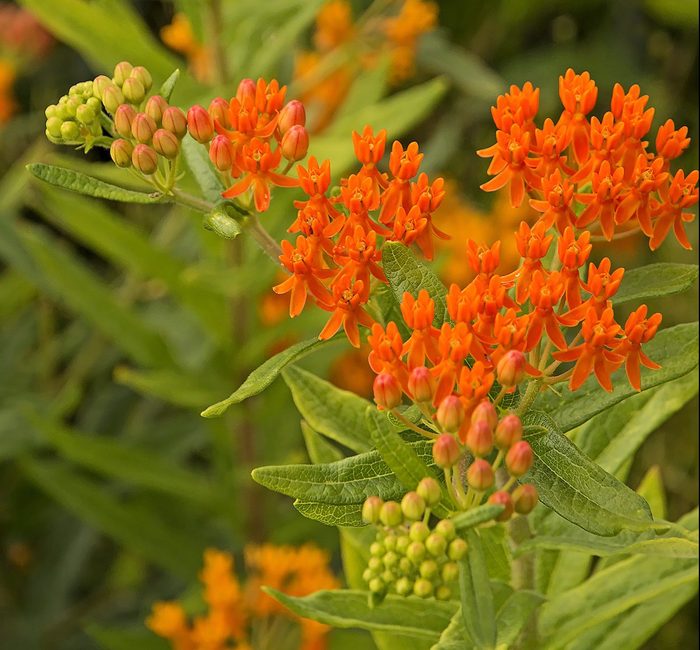
When it comes to planting native butterfly weed, you have plenty of choices. It’s available seed form, as bare milkweed roots, or as live plants in gallon-size containers. You can order seeds or plants online, or you can stop by your local garden center.
One cultivar to try is Gay Butterflies milkweed (zones 4 to 11). Grown by Monrovia, it showcases blooms from mid-to-late summer with fiery gold, yellow and scarlet flower clusters.
For golden flowers, look for the Hello Yellow cultivar.
Next, discover more monarch butterfly flowers you should grow.
About the Expert
Melinda Myers is the official gardening expert for Birds & Blooms. She is a TV/radio host, author and columnist who has written more than 20 gardening books. Melinda earned a master’s degree in horticulture from the University of Wisconsin-Madison.
Sources
- Monarch Joint Venture
- The Xerces Society for Invertebrate Conservation
- Monrovia
- Walters Gardens, Inc.
Why Trust Us
For nearly 30 years, Birds & Blooms, a Trusted Media Brand, has been inspiring readers to have a lifelong love of birding, gardening and nature. We are the #1 bird and garden magazine in North America and a trusted online resource for over 15 million outdoor enthusiasts annually. Our library of thousands of informative articles and how-tos has been written by trusted journalists and fact-checked by bird and garden experts for accuracy. In addition to our staff of experienced gardeners and bird-watchers, we hire individuals who have years of education and hands-on experience with birding, bird feeding, gardening, butterflies, bugs and more. Learn more about Birds & Blooms, our field editor program, and our submission guidelines.
On This Page
Blanket Flower Care and Growing Tips
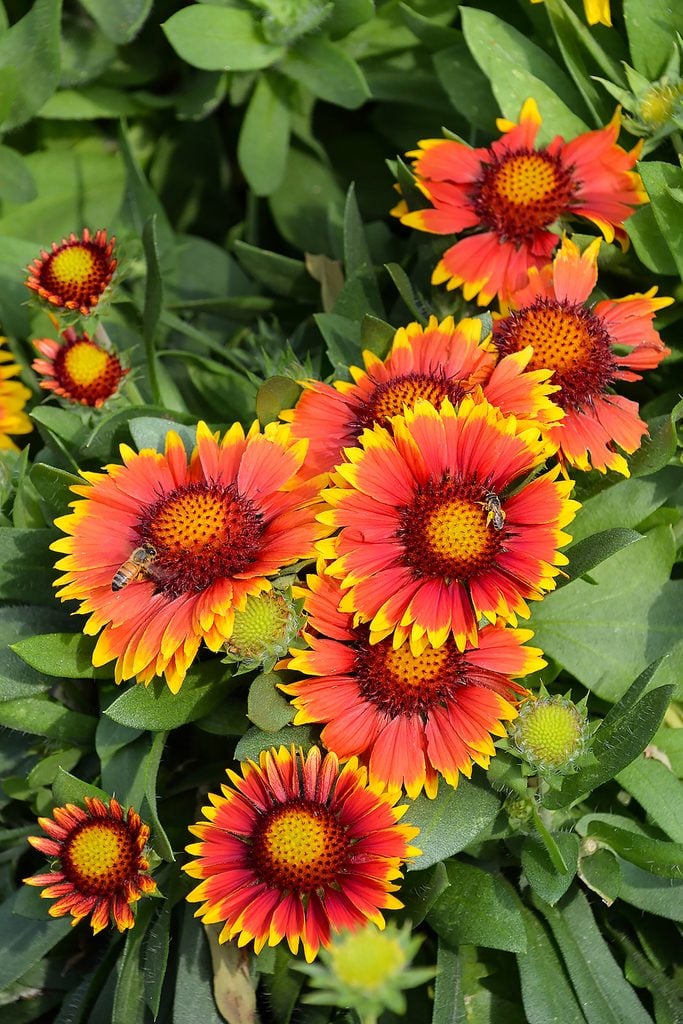
- Botanical name: Gaillardia spp.
- Zones: 3 to 10
- Attracts: Birds, bees and butterflies
- Light needs: Full sun
- Size: 2 to 3 feet tall
- Grown for: An explosion of color and drought tolerance
- Foliage: Long gray-green leaves
- Soil: Well draining
Few plants offer a bright sunburst of color quite like blanket flower (Gaillardia pulchella). Emerging in late spring, the blooms come in a combination of yellow, orange, red and maroon and stick around until September. Budget gardeners looking for a terrific pop of color in their gardens from spring through fall (and nearly year-round in zones 9 and 10) shouldn’t pass up one of our best native wildflowers. Its bright yellow and orange bi-color flowers are produced in abundance for months on end. The plants are easily started from good quality seed.
Blanket Flower Benefits
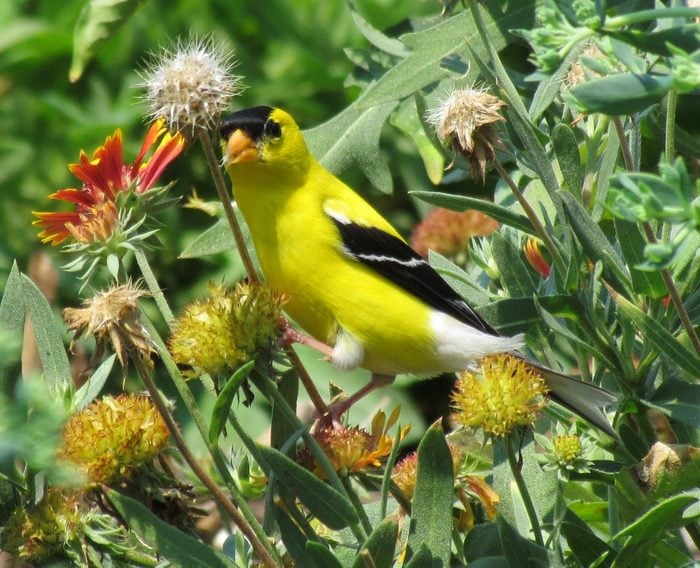
Blanket flower has made multiple Birds & Blooms “best lists”, including flowers that beat the heat and the top 10 plants for sandy soil. This easy-to-grow wildflower is great for pollinators and wonderful for cutting, too. You’ll often find it along roadsides and in wildflower meadows, and anywhere native flowers are emphasized. It does well in containers and is even salt-tolerant. Rabbits usually give it a pass, but goldfinches will snack on the seeds.
These plants ask for nothing but lots of sun, and the occasional bit of rain. However, blanket flower does poorly in clay soil.
Is Blanket Flower an Annual or Perennial?
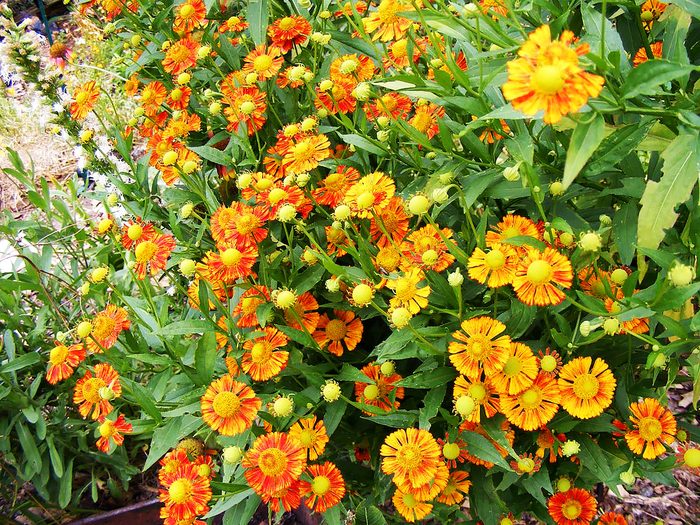
“This plant (above) has been growing in our garden every year for two to three years. The bees love the flowers. Can you tell us what it is?” asks Birds & Blooms reader Thomas Marnocha of South Bend, Indiana.
Garden expert Melinda Myers says, “Your bee-friendly plant is a blanket flower, also known by its botanical name, Gaillardia. There are annual, biennial and perennial species of these plants that flower freely all season long.
Gaillardias thrive in hot, dry conditions and fast-draining soils. In fact, the profuse flowering and intolerance for poorly drained soil often results in perennial varieties not surviving the winter, especially those growing in the North. Fortunately, this does not seem to be a problem in your garden.
For those who have not had the best luck with blanket flowers surviving the winter, try cutting the plant back to six inches in late summer. This encourages the plant to redirect energy from flower and seed production to storage for winter survival.”
Start Blanket Flower From Seed
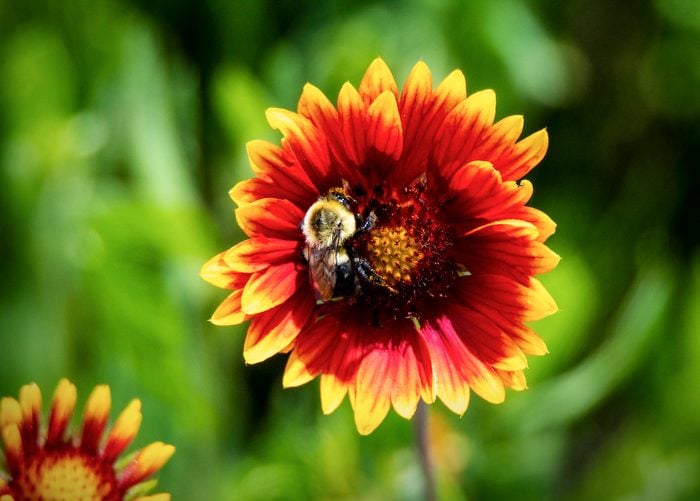
Interestingly, I often come across articles indicating this plant is difficult to start from seed. This always makes me laugh. My own yard is full of Gaillardia and all of it comes from a single packet of seed I purchased years ago from the Florida Wildflowers Growers Cooperative.
From a single $3 investment, I have reaped probably thousands of blooms over the years, on dozens and dozens of plants. They die back after a freeze, and sprout again nearby a few weeks later, Blanket flower gives me reliable blooms here in Florida from late February until winter returns again.
If you live in a colder growing zone, as fall approaches, leave flower stalks and seed heads standing to help the plant become more winter hardy.
Learn how to grow Shasta daisies in your garden.
Blanket Flower Cultivars to Try
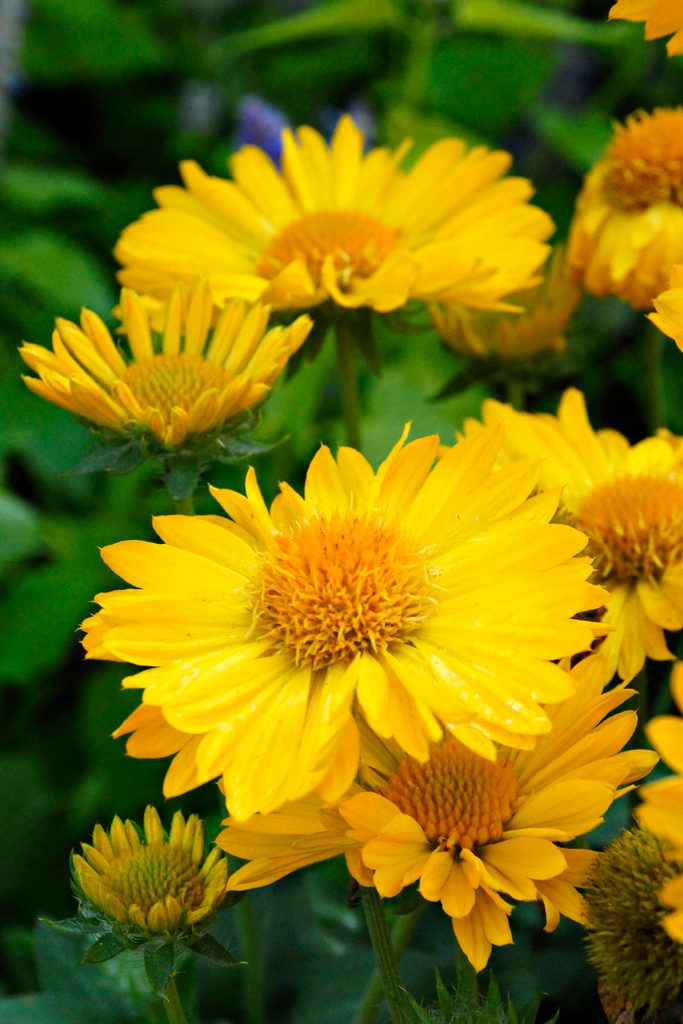
There are also several other Gaillardia species native to the U.S. Many have great value for wildlife or in a cutting garden. You can find single colors, a “pincushion” effect, and more. Mesa Red’s deep red-orange flowers are a dramatic magnet for butterflies. For something a little sunnier, try cheery Mesa Yellow. Arizona Sun also offers classic bicolor.
Next, check out our complete guide to growing coneflowers.
About the Expert
Melinda Myers is the official gardening expert for Birds & Blooms. She is a TV/radio host, author and columnist who has written more than 20 gardening books. Melinda earned a master’s degree in horticulture from the University of Wisconsin-Madison.
Sources
Why Trust Us
For nearly 30 years, Birds & Blooms, a Trusted Media Brand, has been inspiring readers to have a lifelong love of birding, gardening and nature. We are the #1 bird and garden magazine in North America and a trusted online resource for over 15 million outdoor enthusiasts annually. Our library of thousands of informative articles and how-tos has been written by trusted journalists and fact-checked by bird and garden experts for accuracy. In addition to our staff of experienced gardeners and bird-watchers, we hire individuals who have years of education and hands-on experience with birding, bird feeding, gardening, butterflies, bugs and more. Learn more about Birds & Blooms, our field editor program, and our submission guidelines.
On This Page
What Does a Fiery Skipper Look Like?
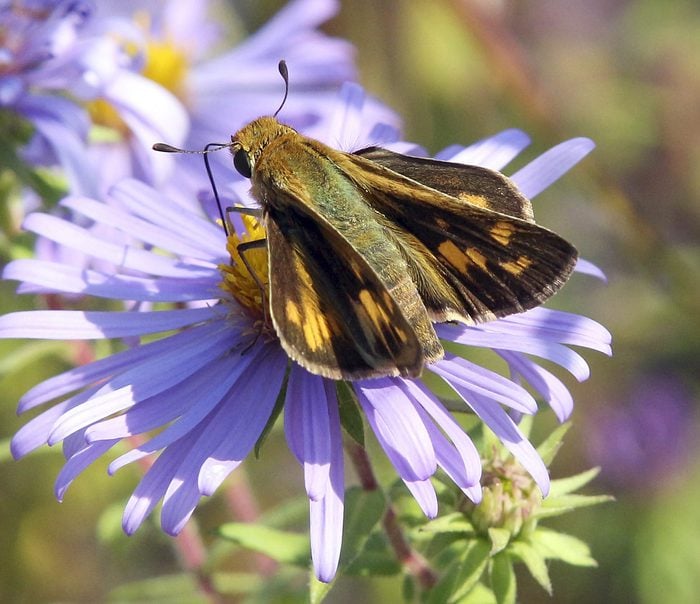
A female fiery skipper has dull orange and dark markings, while males sport a slightly brighter orange, and dark, uneven borders. If you’re able to get close enough to spot the butterfly’s antennae, look for short antennae with knobby ends.
Meet more members of the vast (and fast!) skipper butterfly family.
Is a Fiery Skipper a Butterfly or a Moth?
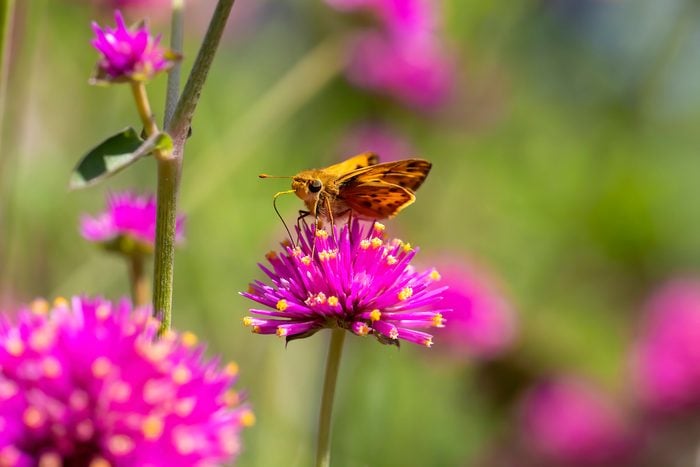
When you’ve found a skipper, you might first think it’s a moth. “Though they’re part of the butterfly family, they have characteristics of moths, too,” says Birds & Blooms contributor Jill Staake. “Many scientists consider them a sort of ‘in-between’ insect.”
Jill also notes that a good way to tell whether you’ve found a skipper is to observe its flight pattern. “They all fly very quickly, ‘skipping’ from flower to flower with a darting flight pattern,” she says.
While skippers are among the smaller butterflies, this subspecies is tiny—even for a skipper. As Jill explains, two common skippers in the United States, the silver-spotted and the long-tailed, have wingspans of up to 2 1/2 inches. The fiery, on the other hand, has a wingspan of 1 to 1 1/2 inches.
Fiery Skipper Range and Habitat
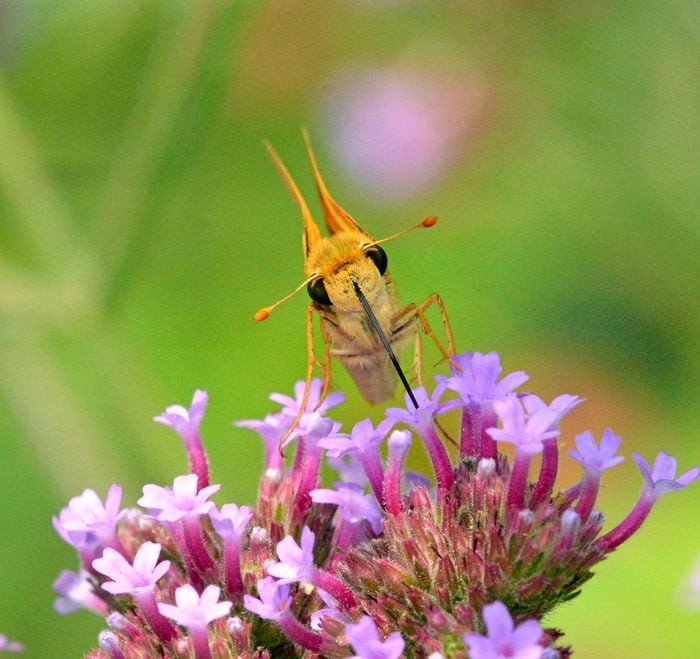
These slight butterflies are commonly found in the southern United States, as well as Central and South America. They visit the northern United States during summer, and tend to depart once the first frost sets in.
“Fiery skippers can’t tolerate harsh winters, so they live year-round in the southern areas of the country and expand their population north during the spring and summer months,” Jill says. “They overwinter as pupae in the leaf litter, emerging in spring when the first wildflowers begin to bloom.”
Butterfly enthusiasts can find them flitting across fields, flower gardens and roadsides. “They’re really common in summer in much of the country,” Jill says, “especially in suburban areas because their caterpillars feed on the types of turf grasses people usually use in their yards.”
Meet more small butterflies you should never overlook.
Host Plants and Caterpillar
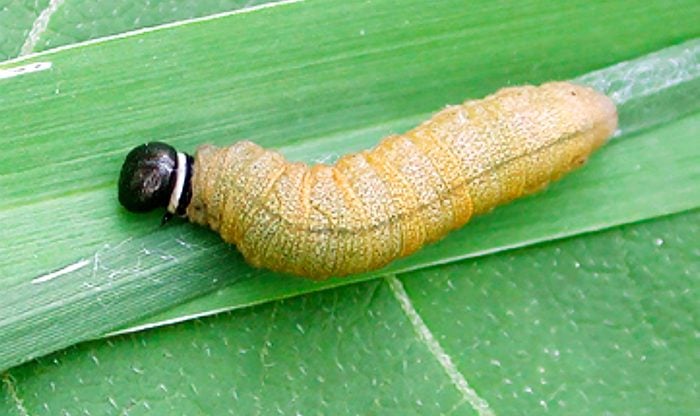
As Jill mentioned, these tiny skippers lay their pearl-like white eggs on grasses, including Bermuda grass, crabgrass, and St. Augustine’s. Caterpillars eat the grasses as they grow and even use the grass to form a shelter. Caterpillars roll and tie grasses with silk.
There’s little doubt when you’ve spotted a fiery skipper caterpillar. Initially greenish, the caterpillar eventually morphs into brown with a long, darker stripe down its back and several fainter stripes. A large, almost black head area is noticeable.
Here’s how to grow native ornamental grasses for butterflies—especially skippers.
About the Expert
Jill Staake‘s lifelong love of nature turned into a career during the years she spent working with native Florida butterflies, caterpillars, and other wildlife at the Museum of Science & Industry in Tampa, Florida. During this time, she helped to maintain 30+ acres of gardens and backwoods, all carefully cultivated to support the more than 20 species of butterflies displayed indoors and out. She now writes for a variety of publications and sites on topics like gardening, birding, and education, among others.
Sources
- Missouri Department of Conservation, “Fiery Skipper”
- Entomology Department: University of Florida, “Fiery Skipper”
- Butterflies and Moths of North America, “Fiery Skipper”
Why Trust Us?
For nearly 30 years, Birds & Blooms, a Trusted Media Brand, has been inspiring readers to have a lifelong love of birding, gardening and nature. We are the #1 bird and garden magazine in North America and a trusted online resource for over 15 million outdoor enthusiasts annually. Our library of thousands of informative articles and how-tos has been written by trusted journalists and fact-checked by bird and garden experts for accuracy. In addition to our staff of experienced gardeners and bird-watchers, we hire individuals who have years of education and hands-on experience with birding, bird feeding, gardening, butterflies, bugs and more. Learn more about Birds & Blooms, our field editor program, and our submission guidelines.
On This Page
Elderberry Bushes Attract Backyard Birds
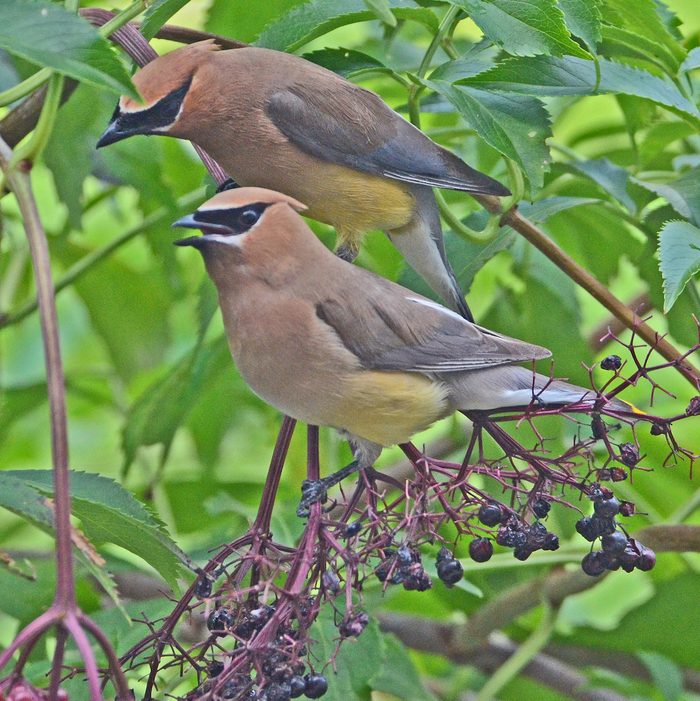
This one of our berry facts is for the bird lovers. One of the best ways to bring in birds to your backyard is to plant bushes with berries. Birds that don’t usually visit feeders—such as stunning cedar waxwings—will readily eat fruit. Elderberry shrubs are known to feed more than 30 bird species, such as cedar waxwings, northern mockingbirds and gray catbirds. Plus, they provide shelter and nest sites.
No space to grow a berry bush? Consider putting out grape jelly for fruit-eating birds.
Raspberries Are More Colorful Than You Think
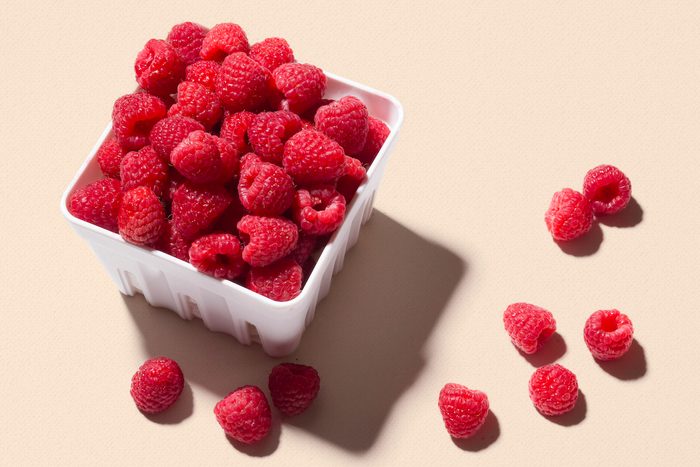
You probably knew raspberries are red, but you probably weren’t aware that they come in more than one color. They’re also available in black, purple, and gold. Black raspberries tend to be smaller than the red variety typically sold in supermarkets, and they are primarily used for cooking.
When you’re done looking at berry facts, check out these fascinating facts about carrots.
Check Restrictions Before Planting These Berries
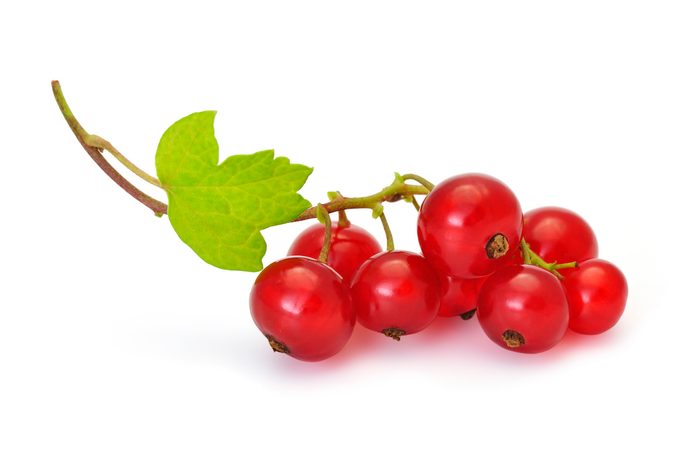
It was illegal to grow currants (shown above) and gooseberries in the U.S. until 1966. They were hosts to white pine blister rust, a fungus that destroys white pine trees. Some states still have restrictions in place. In those states, growing these berries may require a special permit.
Are American pokeweed berries poisonous?
You Can Grow Blueberries in Your Backyard
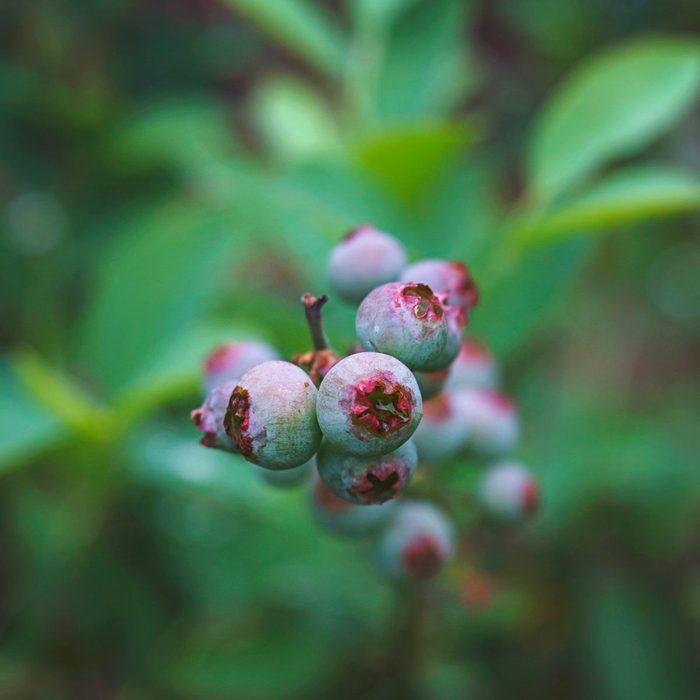
Put down the grocery-store blueberries! Growing these sweet fruits in your backyard is easier than you might think, but you need to make sure you have the correct growing conditions. Blueberries prefer soil as acidic as 4 to 5 pH. You may need to test your soil for guidance on adjusting your pH before you plant blueberries.
For more berry facts, check out our blueberry growing guide.
A Banana’s Technical Classification Might Surprise You
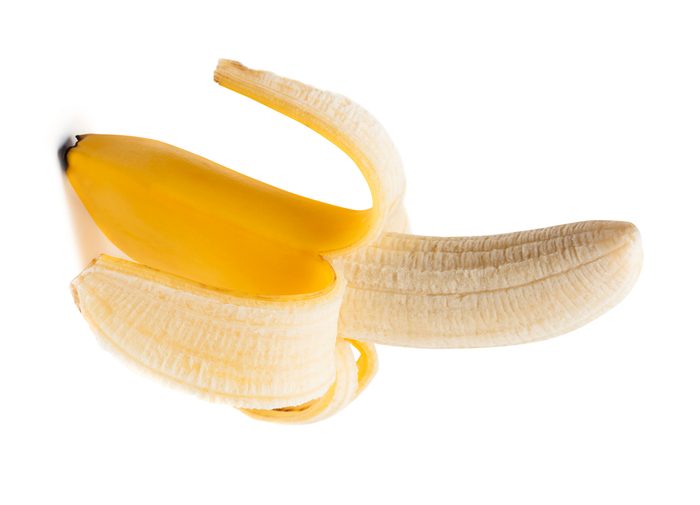
You’ve probably never thought of a banana as a berry, but it is one. Botanically, a banana is a berry because it is produced from an individual flower containing one ovary. Modern cultivars are seedless.
Grow brandywine viburnum for tie-dye berry clusters.
Cherries Are Not Berries
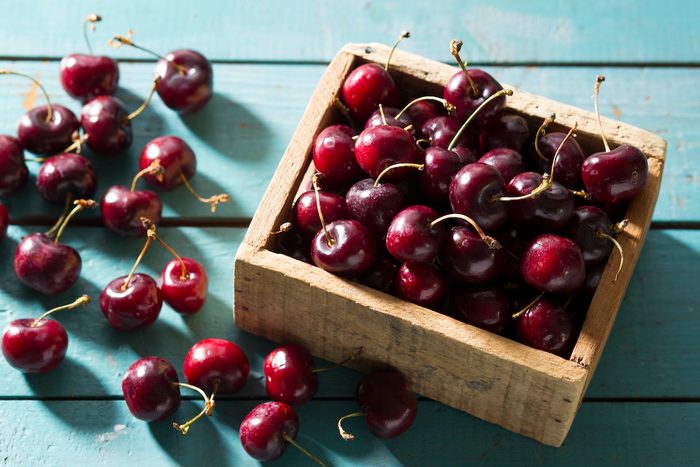
Equally surprisingly, despite their rhyming names, a cherry is not a berry—it’s classified as a stone fruit. Other types of stone fruits include peaches, plums and apricots.
Get expert tips on growing cherries.
Some Blackberries Don’t Have Thorns
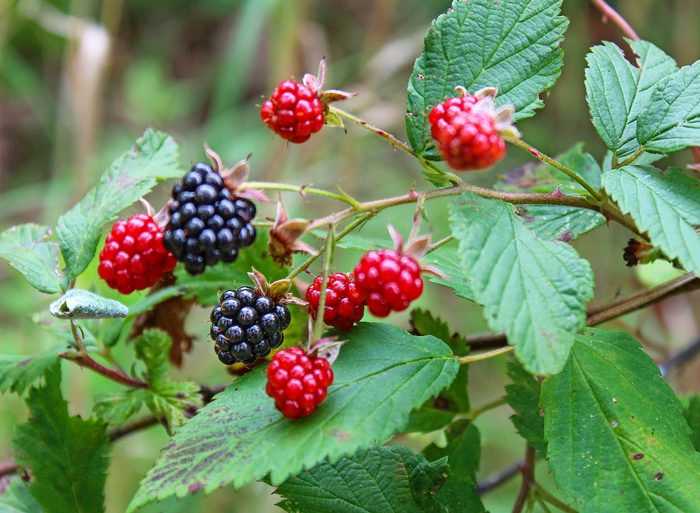
While they don’t have as many different colors as raspberries, blackberries still technically have two different forms: with or without thorns.
Next, learn how to grow a black chokeberry shrub.
Additional reporting by Emily Hannemann
Sources
Penn State Extension, “Raspberry Planting and Care for Home Gardeners”
Penn State Extension, “Brambles in the Home Fruit Planting”
Bur Oak Land Trust, “Elderberry: For the Birds”
University of Minnesota Extension, “Growing Stone Fruits in the Home Garden”
Stanford Magazine, “Bananas Are Berries?”
Why Trust Us?
For nearly 30 years, Birds & Blooms, a Trusted Media Brand, has been inspiring readers to have a lifelong love of birding, gardening and nature. We are the #1 bird and garden magazine in North America and a trusted online resource for over 15 million outdoor enthusiasts annually. Our library of thousands of informative articles and how-tos has been written by trusted journalists and fact-checked by bird and garden experts for accuracy. In addition to our staff of experienced gardeners and bird-watchers, we hire individuals who have years of education and hands-on experience with birding, bird feeding, gardening, butterflies, bugs and more. Learn more about Birds & Blooms, our field editor program, and our submission guidelines.
On This Page
Costa Rica Hummingbirds You Should Know
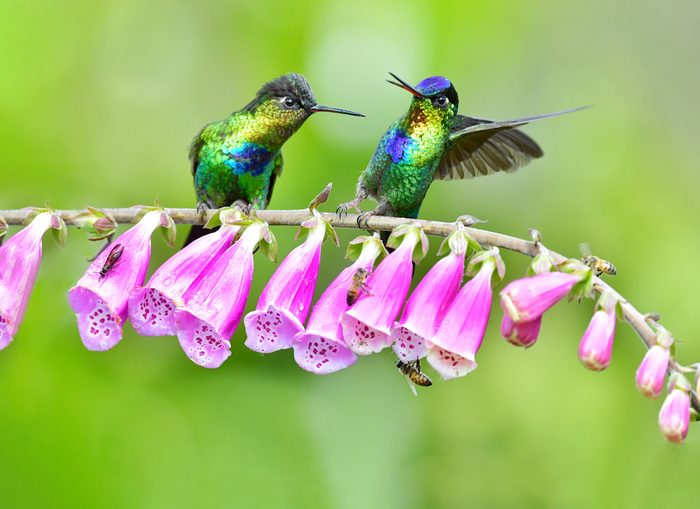
With their vibrant colors, hummingbirds seem as if they belong in the tropics—and they do. Fewer than 20 species of these little gems can be found found regularly in all of the United States and Canada. By contrast, the tiny, beautiful nation of Costa Rica—less than half the size of Ohio—hosts more than 50 hummingbird species. Here are a few favorites among the many types of hummingbirds that call Costa Rica home.
Volcano Hummingbird
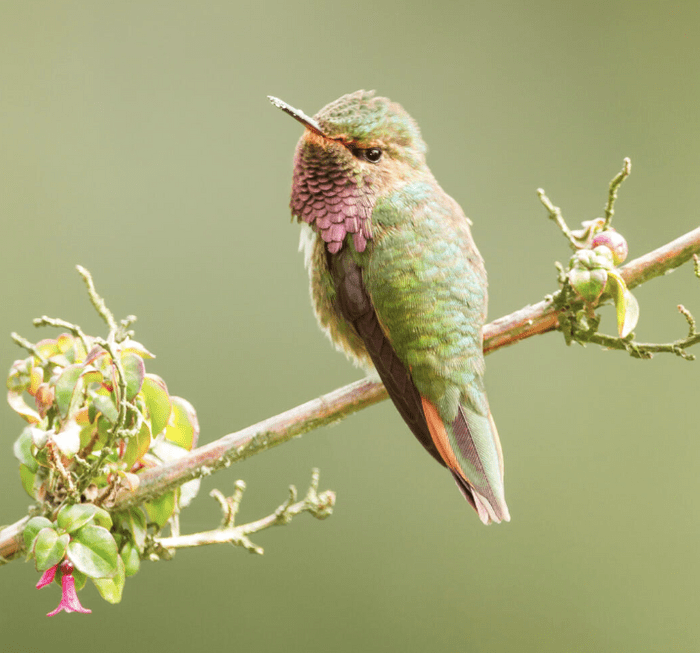
Related to the rufous hummingbird of North America, the volcano hummingbird is a very small species living only in Costa Rica and a small portion of western Panama. It’s a common resident in the high mountains, zipping about in open meadows and the edges of scrubby forests.
Adult males have bright iridescent colors on the throat. The exact color varies on different mountaintops. It varies from reddish to purple, blue-gray or green. On females, the throat is white with dark spots.
Fiery-throated Hummingbird
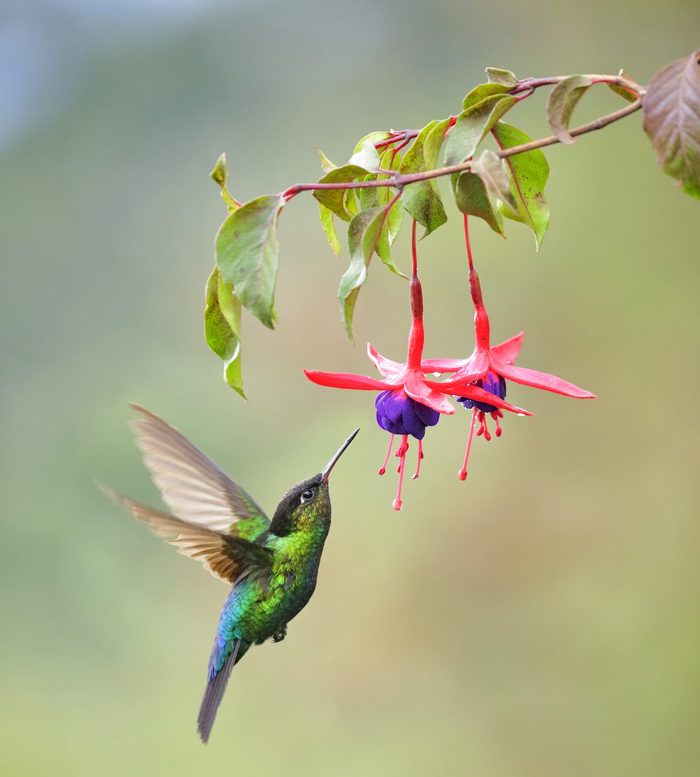
When seen in the shadows, it can look like the plainest of hummingbirds, just a dull green all over. But let the light hit it just right, and the fiery-throated truly lives up to its name. The throat feathers flash a bold mix of red, gold and bronze, with dashes of blue and purple on the head, chest and tail.
Fiery-throated hummingbirds are fairly common in mountainous forests that run the length of Costa Rica. These fliers aren’t seen anywhere else except parts of western Panama.
Psst—discover 5 secret hummingbird travel sites to visit.
Long-billed Hermit
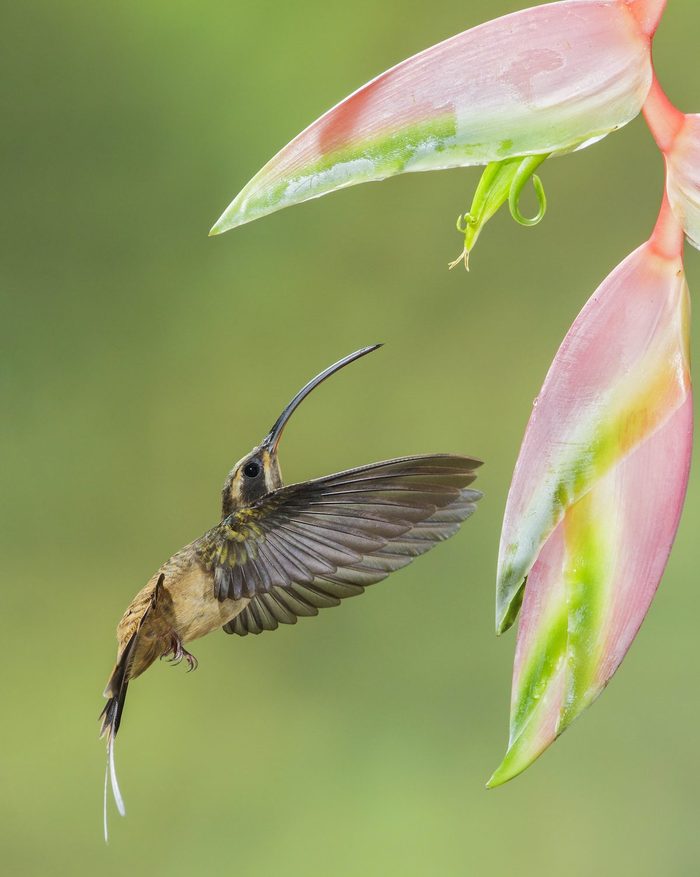
The hermits make up a group of medium-sized to large hummingbirds that live in the shaded forest interior. Most of them have long, curved bills and elongated central tail feathers. Several kinds live in Costa Rica, but the long-billed hermit is one of the most widespread, found in tropical forests throughout the lower elevations of the country.
Long-billed hermits can be tricky to observe. They move about inside the forest, visiting isolated flowers. Often they’re noticed first by their sharp, high-pitched call note as they zoom past, trailing their long white central tail feathers.
Purple-crowned Fairy
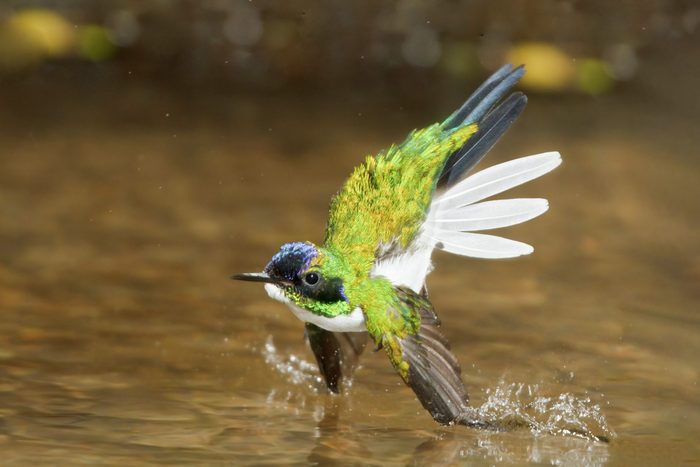
This large hummingbird often stays high, hovering around flowers in the mid to upper levels of trees at tropical forests’ edges in the valleys and lowlands. Fortunately it’s still easy to spot because it often spreads and flips its long tail while hovering, flashing the white outer tail feathers.
In addition to its tail pattern, identify this bird by the contrast between its bright white underparts and green back. The purple crown of the male is often hard to see.
White-crested Coquette
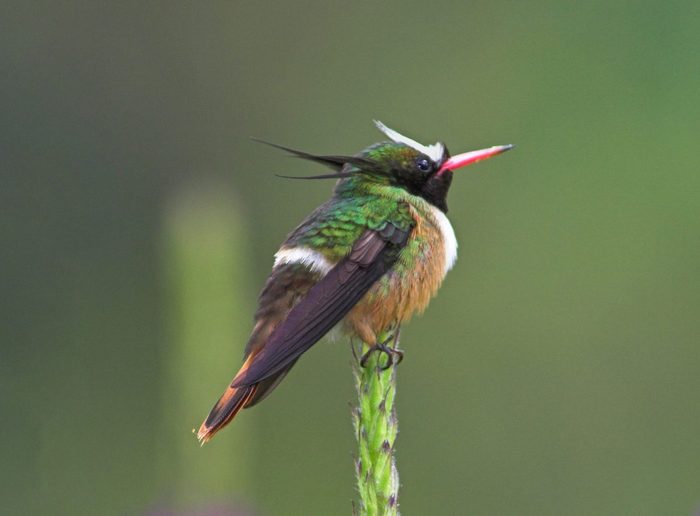
One of the most sought-after hummingbirds in Costa Rica, birders commonly spot the tiny white-crested coquette in the country’s southwestern lowlands. Green on the back and washed with orange on the belly, both males and females have a white band across the lower back. In addition, the male has narrow green plumes at the side of the throat and a perky white crest.
A former name for this species, “adorable coquette,” seems totally appropriate.
Meet the calliope hummingbird: the smallest bird in the U.S.
Rufous-tailed Hummingbird
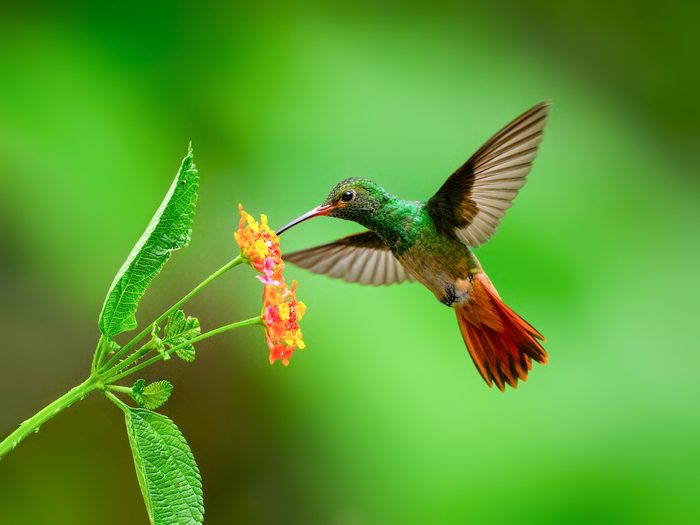
Probably the most common hummingbird in Costa Rica, the rufous-tailed is found almost everywhere at low to middle elevations. It thrives in dry scrub in the northwestern part of the country, in the edges of wet tropical forests, along roadsides, in suburban gardens, and even in the middle of the capital city of San Jose.
Aside from their bright reddish brown tails, adults are mostly bright pale green with red bills. The male often sings from a favorite high perch, giving a series of thin, high-pitched notes.
Snowcap
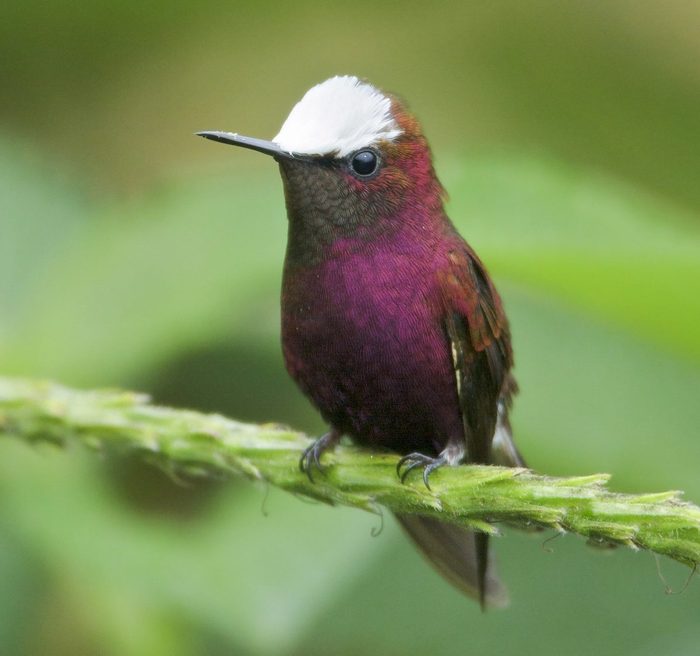
A unique little gem, the male snowcap is mostly a dark reddish or bronzy purple but with a bright white cap and white outer tail feathers. The female, with a green back and white underparts like many other hummingbirds, is less distinctive.
Snowcaps are found in four Central American countries, from Honduras to Panama. But they are seen most regularly in the foothills of Costa Rica.
Up to six male snowcaps may perch on exposed twigs at the edge of a clearing and sing a soft, rambling song to attract the attention of females.
Learn how to identify a broad-billed hummingbird.
Violet Sabrewing
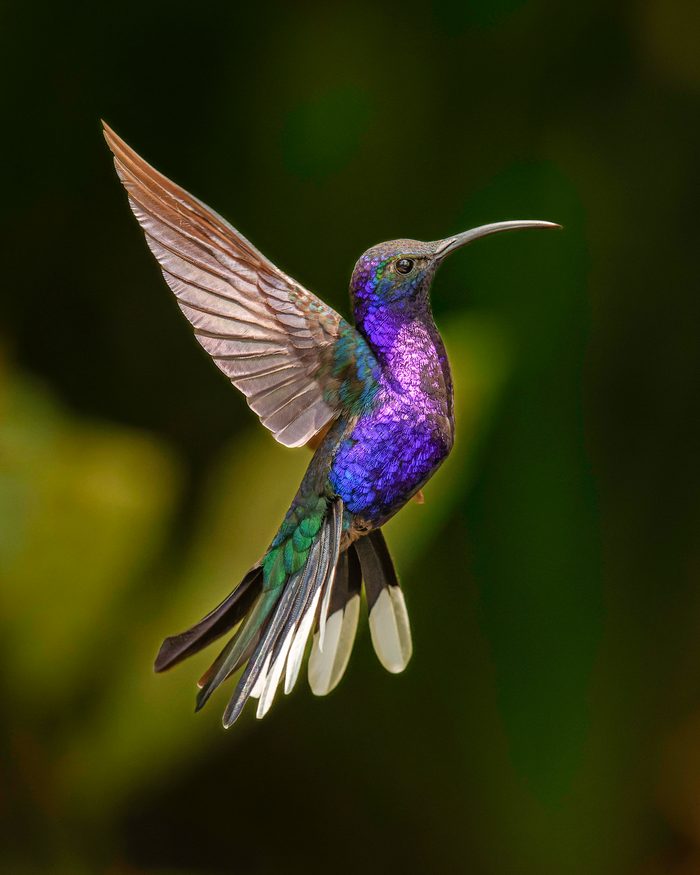
The male violet sabrewing is unmistakable: a large, dark hummingbird with mostly deep purple on the head and chest, green on the back and wings, long curved bill, and big white patches in the tail. The female is a little plainer, with purple only on the throat. But she has the same bill shape and bold white tail spots.
Violet sabrewings live in the foothills and mountains in Costa Rica, ranging through the understory and mid-levels of the forest.
What makes hummingbird feathers so shimmery?
Go Birding to See Costa Rica Hummingbirds

Although multiple species of hummingbirds can be found almost anywhere in Costa Rica, no single spot has them all. Each kind has their own habitat preferences. Some thrive in lowlands, some live in mountainous mid-level areas, and some are found mainly near higher peaks. To see a good variety, plan to go birding at different elevations.
Fortunately, in this small country, it’s easy to travel from low valleys to higher slopes in a short time. Costa Rica has many tourist lodges that cater to bird-watchers and naturalists. Many of these locations have gardens to attract hummingbirds. When planning a visit, ask ahead about these opportunities and facilities.
- Head to the mountains and stay at Paraiso Quetzal Lodge, a fantastic place to relax and see the many high-elevation species of hummingbirds found in Costa Rica. You may spot a fiery-throated hummingbird or lesser violetear.
- Put your eyes to the skies at Rancho Naturalista, a lodge located in the lush rainforest. The snowcap, a tiny purple hummingbird with a white cap on its head, stops by regularly.
- Grab a bite to eat and keep your eyes open for hummingbirds at a delightful roadside diner, Galeria de Colibries y Restaurant Cinchona. The back patio offers the best seats in the house. Bird-watch at the Virgen del Socorro canyon near the restaurant.
Why Trust Us
For nearly 30 years, Birds & Blooms, a Trusted Media Brand, has been inspiring readers to have a lifelong love of birding, gardening and nature. We are the #1 bird and garden magazine in North America and a trusted online resource for over 15 million outdoor enthusiasts annually. Our library of thousands of informative articles and how-tos has been written by trusted journalists and fact-checked by bird and garden experts for accuracy. In addition to our staff of experienced gardeners and bird-watchers, we hire individuals who have years of education and hands-on experience with birding, bird feeding, gardening, butterflies, bugs and more. Learn more about Birds & Blooms, our field editor program, and our submission guidelines.
On This Page
What Does a Broad-Billed Hummingbird Look Like?
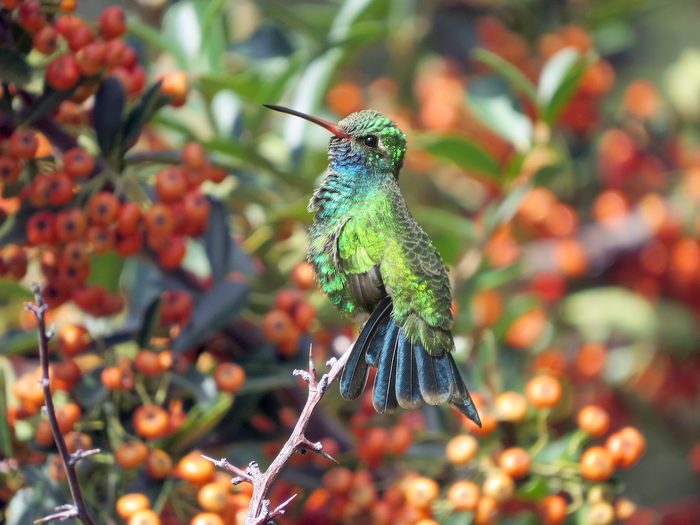
Even for hummingbirds, broad-billed hummingbirds are stunning little creatures. The males sport vibrant emerald bodies, iridescent sapphire throats and bright red bills tipped with black. The females deserve equal admiration with their sleek gray bodies and a distinct white line next to each eye.
“This is the wow hummingbird of North America,” says Dan Weisz, an expert naturalist, photographer and volunteer presenter at the Arizona-Sonora Desert Museum.
And they’re not all that hard to see most of the year as they flit from backyard feeders to their favorite native flowers.
Range and Habitat
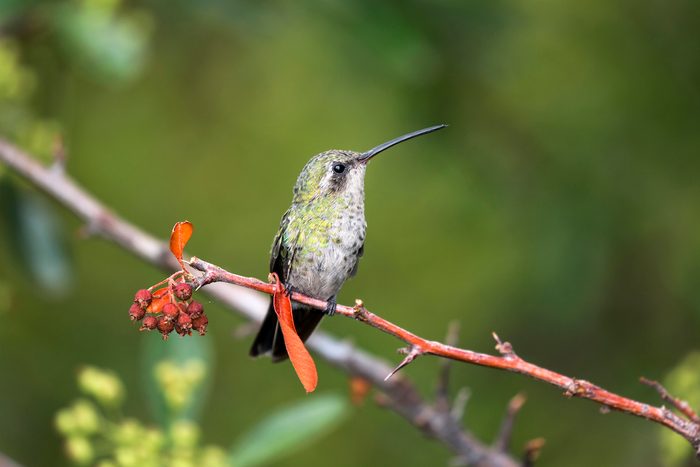
The broad-billed hummingbird lives predominantly in Mexico and southeastern Arizona. However, its range is expanding as more birds overwinter in the U.S.
They’ve also turned up in unexpected places such as California, Oregon and even the Great Lakes region. Two recent sightings in Colorado turned out to be birds originally banded in Louisiana, says Sheri Williamson, author of Peterson’s A Field Guide to Hummingbirds of North America.
“They have a penchant for wandering,” she says. “That can cause pretty thrilling responses when you look out your window.”
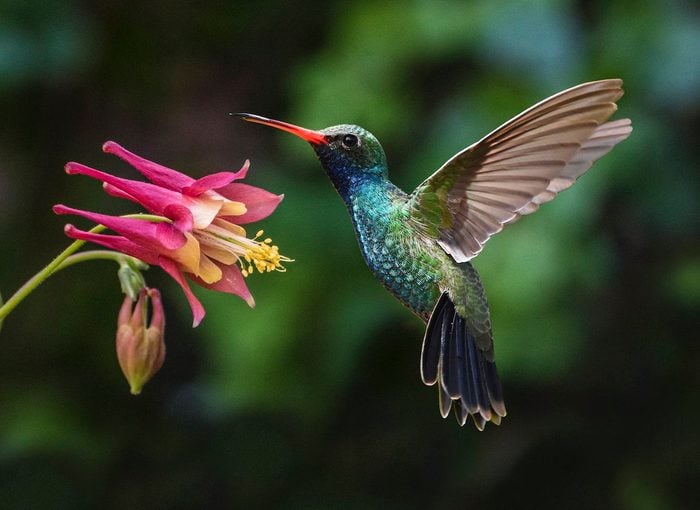
Dan suggests heading to the Tucson area in the spring, summer or fall for a chance to see these jeweled fliers. Visit the Paton Center for Hummingbirds and Santa Rita Lodge. Also look for the birds in lower foothills with thorny vegetation and oak trees.
Learn more about amazing Arizona hummingbirds (and the best places to see them).
Calls and Sounds
Bird sounds courtesy of the Cornell Lab of Ornithology
For Sheri, the broad-billed hummingbird is more than lovely feathers. It’s crafty, bold and curious.
During banding at the Southeastern Arizona Bird Observatory, the birds raise a ruckus when handled, but when released near food, they stand up and proudly look around. She’s even had one buzz over her head while flying back and forth to a backyard feeder.
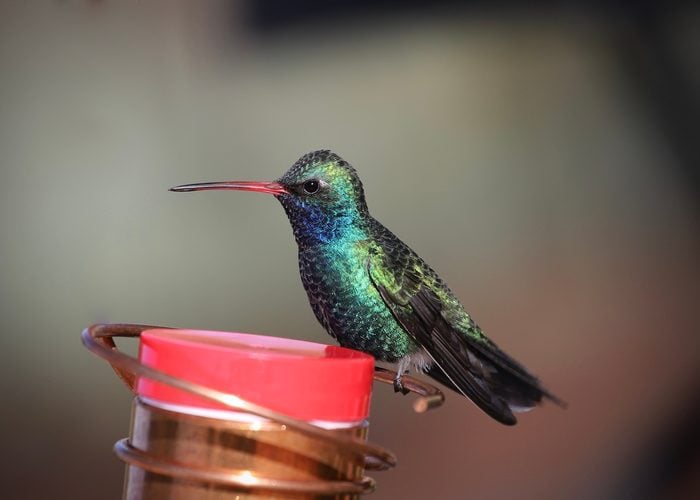
“He was letting me know the sugar water was not up to his standard,” Sheri says. “Even if broad-bills were the ugliest hummingbird on the planet, they would be fascinating because of their behavior and intelligence.”
Nesting Habits
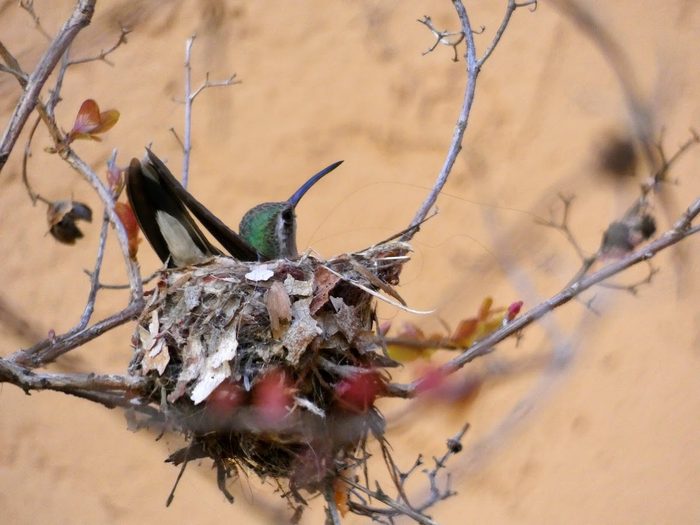
When it comes to attracting mates, these showy birds never needed to develop advanced aerial acrobatics like other hummingbirds, possibly because they’re so naturally flashy, according to Sheri. The males simply fly back and forth in front of females, singing along with their easy movements.
To avoid predation, the broad-billed hummingbird builds its nests on long, thin branches or in clusters of vines. “Then, snakes don’t have a whole lot to hang onto. They’re more likely to fall off before they actually get to where the eggs and babies are,” Sheri says.
Broad-bill nests are also uniquely deep, requiring the female to fold almost in half as she rests on her eggs. Even more intriguing, observers have noticed that females often build nests underneath or near hawks’ nests, possibly as a way to protect their babies from other predators.
Sheri’s take on this interesting partnership? “The enemy of my enemy is my friend,” she says.
About the Experts
A retired public school educator, Dan Weisz has been a volunteer presenter at the Arizona-Sonora Desert Museum for several years. He is a naturalist, photographer and birder.
Sheri Williamson is a naturalist, ornithologist, writer and public speaker. She is the author of A Field Guide to Hummingbirds of North America, part of the Peterson Field Guide series.
Sources
- Tucson Audubon
- Paton Center for Hummingbirds
- Santa Rita Lodge
- U.S. Forest Service
- National Audubon Society – broad-billed hummingbird
- All About Birds – Broad-billed hummingbird
Why Trust Us
For nearly 30 years, Birds & Blooms, a Trusted Media Brand, has been inspiring readers to have a lifelong love of birding, gardening and nature. We are the #1 bird and garden magazine in North America and a trusted online resource for over 15 million outdoor enthusiasts annually. Our library of thousands of informative articles and how-tos has been written by trusted journalists and fact-checked by bird and garden experts for accuracy. In addition to our staff of experienced gardeners and bird-watchers, we hire individuals who have years of education and hands-on experience with birding, bird feeding, gardening, butterflies, bugs and more. Learn more about Birds & Blooms, our field editor program, and our submission guidelines.
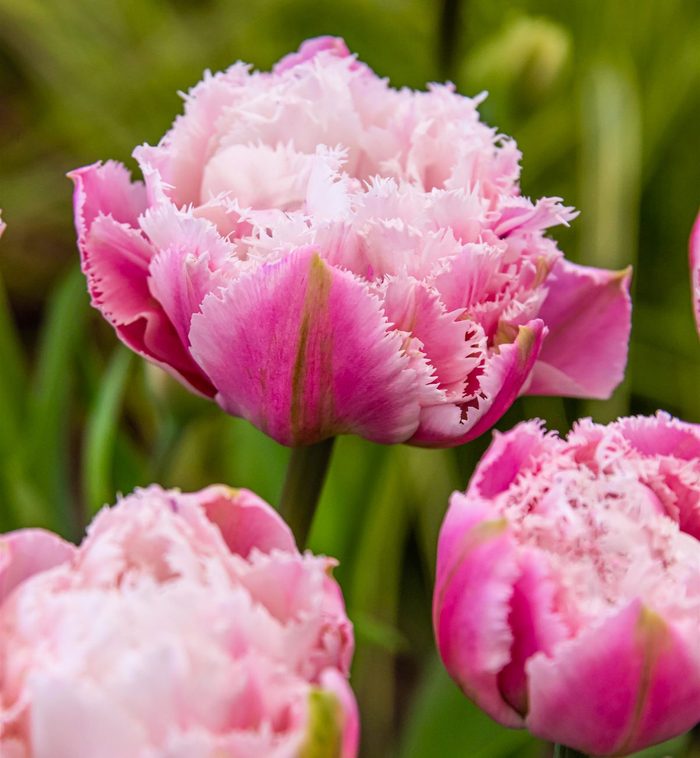
Sugar Crystal Double Tulips
- Tulipa
- Zones 3 to 8
- Light needs: Full sun to part shade
- Size: 12 to 16 inches tall
- Bloom time: Mid to late spring
- Foliage: Light green and upright
- Soil: Well-draining
If you’re looking for head-turning tulip power, this plant’s double baby pink blooms are it. Look closely at the tulip’s feathery petal edges—they almost appear to have a silver tint to them. Like all tulips, Sugar Crystal likes to be in well-draining soil.
These gorgeous, textured blooms are ideal for cut-flower arrangements. While some tulips have floppy foliage, these
have stiff, upright foliage.
One word of caution: Tulips are deer candy. Keep deer away by following instructions on deer deterrents or repellents.
Check out the top 10 types of tulips to plant in your garden.
Fall Planting Guide for Double Tulips
Plan ahead for next spring by purchasing Sugar Crystal double tulip bulbs in time for fall. Plant them at least 6 inches deep and spaced about 6 inches apart.
Dave Dowling, cut flower specialist with Ball Seed says, “Home gardeners planting tulips should remember that tulips need soil that drains well. They should be in an area with full or part sun. Water the bulbs well when planting. They need a cold vernalization period after planting–usually 12 weeks of temperatures near or below freezing at night.”
Next, discover fascinating tulip facts you don’t know.
About the Expert
Dave Dowling is a cut flower specialist with Ball Seed company. He owned a cut flower farm in Maryland for 20 years and previously served as the Mid-Atlantic Regional Director of the Association of Specialty Cut Flower Growers.
Sources
- Ball Horticultural Company
- White Flower Farm
- Dutch Grown
Why Trust Us
For nearly 30 years, Birds & Blooms, a Trusted Media Brand, has been inspiring readers to have a lifelong love of birding, gardening and nature. We are the #1 bird and garden magazine in North America and a trusted online resource for over 15 million outdoor enthusiasts annually. Our library of thousands of informative articles and how-tos has been written by trusted journalists and fact-checked by bird and garden experts for accuracy. In addition to our staff of experienced gardeners and bird-watchers, we hire individuals who have years of education and hands-on experience with birding, bird feeding, gardening, butterflies, bugs and more. Learn more about Birds & Blooms, our field editor program, and our submission guidelines.
On This Page
Can Birds Improve Your Mental Health?
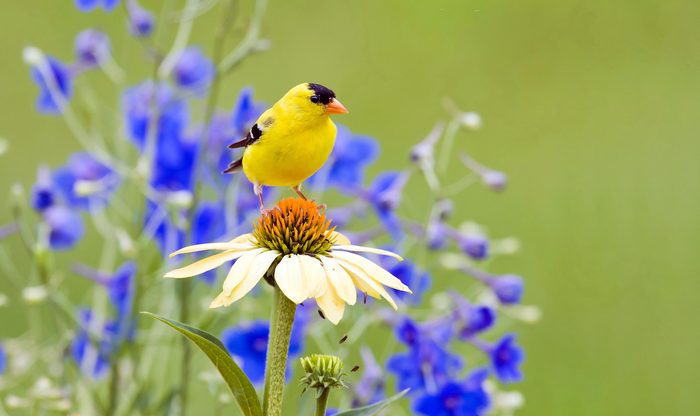
Cardinals, chickadees, juncos, woodpeckers … action! My feeders are full of life. I’ve been feeding birds since I was a little kid. But I only recently reflected on why I have kept feeding them for so many years.
Birds can find food on their own. I know their survival doesn’t depend on me, although I do hope my bird feeders help them in hard times. Personally, feeding birds makes my life better. Watching them right outside my window brings me reliable peace and joy. And there is research that shows watching birds boosts mental health.
Discover the mental and physical health benefits of gardening.
Finding Joy in Feeding Birds
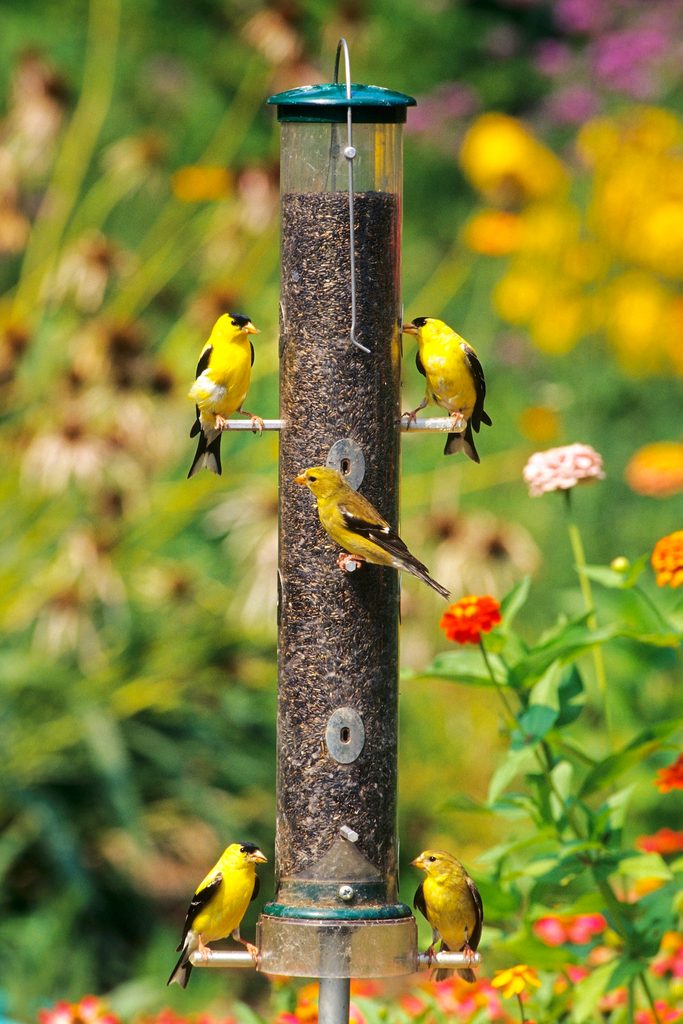
It’s such a simple way to improve my mental well-being. And it’s not just me. Feeding birds as a pastime exploded in popularity during the COVID-19 pandemic. A recent Audubon article described a measurable boom in birdseed sales that began then and continues today—evidence that bird feeding fulfills our human need for connection.
I was delighted to see that the Cornell Lab of Ornithology’s Project FeederWatch collects data on these benefits. Their current data entry portal includes two places for observers to rank the emotional states they experience while conducting monthly feeder surveys. I had no hesitation in giving my bird survey the happiest ranking available!
My friend, Alanna, posted a picture of her brand-new but still empty feeders on Facebook. She was worried because birds were not visiting them. I commented on the post, sharing perspective on being patient while her neighborhood birds discover her offerings. I then followed up with an email asking if she could tell me why she decided to start feeding at the start of 2024.
She responded: “As someone who struggles with anxiety, it can be almost debilitating to think about getting out of the house in pursuit of birding opportunities. Having an at-home bird feeder alleviates that anxiety.” I told her I also find observing birds boosts mental health.
The Healing Power of Nature
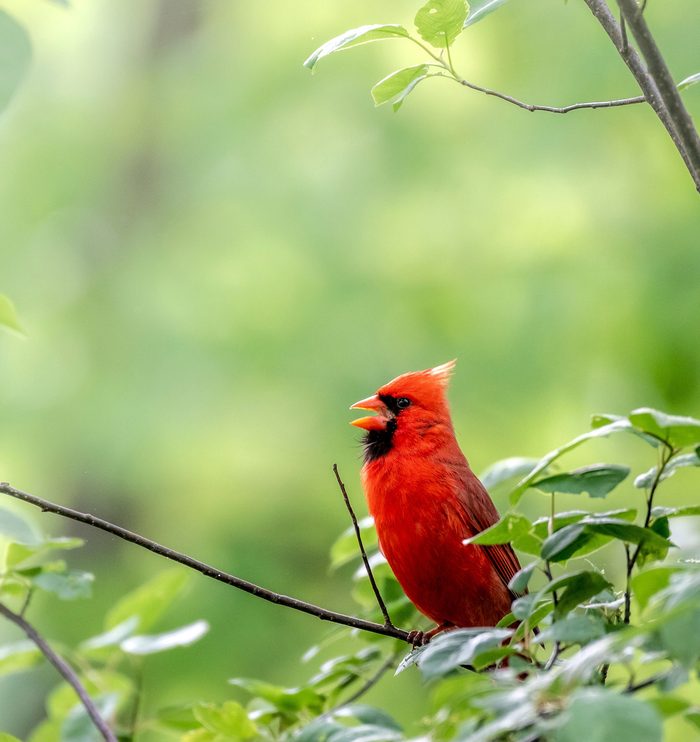
The number of books touting the positive effects of exposure to nature on mental health increases yearly. A quick search nets a flock of popular titles that reflect the underlying surge in academic studies combining interdisciplinary research from fields as far-flung as ecology, theology, psychology, medical science, urban planning, gardening and landscape architecture—well, the connections are seemingly endless.
But why is nature so healing? Two psychology professors at the University of Michigan, Rachel and Stephen Kaplan, found an answer through their research on two types of attention: directed attention and fascination. Because we spend much of our time in directed attention, focused on doing and thinking, they found this results in directed energy fatigue. And spending time in nature, a form of fascination, allows people to reset from task-driven fatigue.
If you see a cardinal, here’s what it means.
Building Resilience
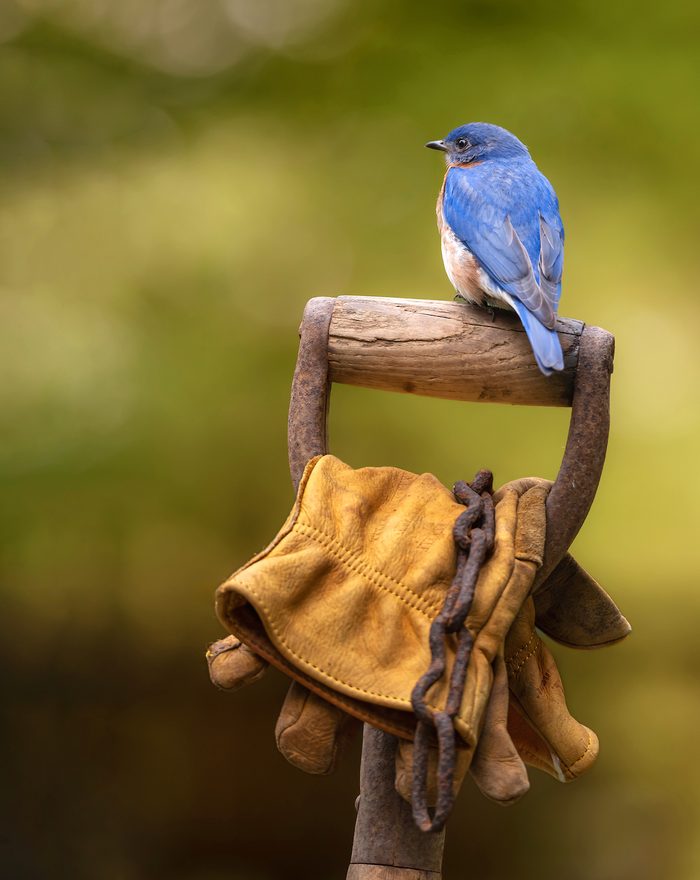
Following this same thread, Terry Hartig, a professor in the psychology department of Uppsala University in Sweden, conducted research on “restorative environments.” In particular, his research focused on how contact with nature can help build resilience in several areas of modern life.
Licensed therapist Tammah Watts first experienced the healing properties of bird-watching in the face of chronic pain. Eager to share her discoveries, she penned a how-to guide called Keep Looking Up, full of tips for connecting birds with mental and spiritual well-being.
And in one recent study, researchers directed more than 1,200 participants to use a smartphone app called Urban Mind to collect data on how they felt after hearing or seeing birds. Encouragingly, the results concluded that observing birds had positive effects on people with and without depression.
So it seems like the link between watching birds and mental health is not just wishful thinking—it’s a researched and documented subject of many scientific studies. More simply, think of watching your feeders as a little spa for your mind and spirit— and it’s one with unlimited visits.
Here’s to your mental health, and the well-being of your feeder birds!
Restorative Reflections
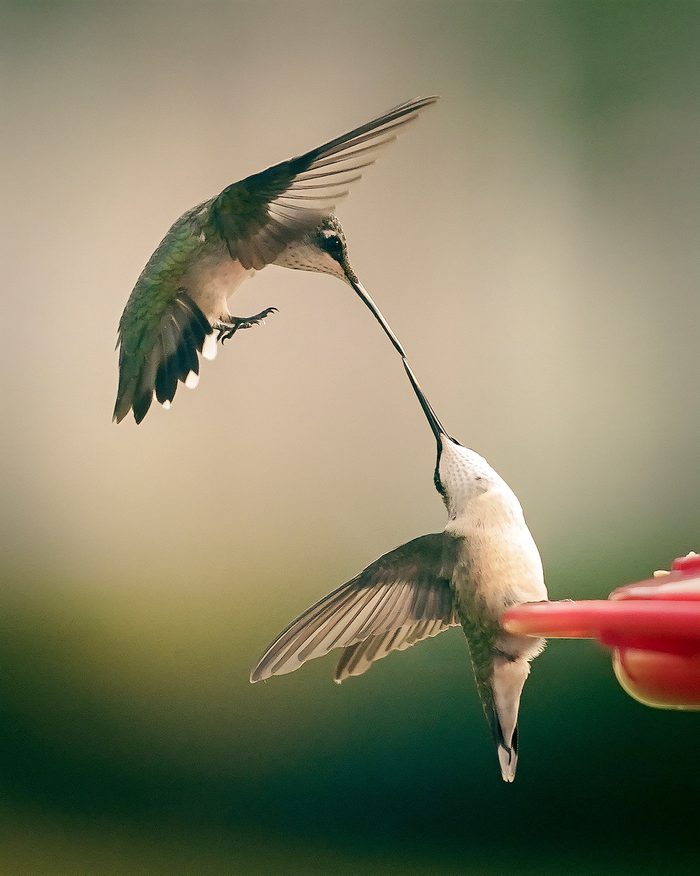
Here are four different ways I experience mental restoration with feeder-watching. This list may give you some ideas for your own experience.
- Birds pull me out of my worries and self-absorption. Looking at birds, even for an instant, I find respite from everyday worries and planning. I’m living in a restorative frame of mind when I revel in the brilliant scarlet of a cardinal.
- Birds mark the seasons. I look forward to a purple finch arriving from the North as much as I anticipate American goldfinches changing from drab beige to brilliant yellow in early spring. My feeder birds remind me of the resilience of life.
- Birds bring unexpected drama. Anticipation and excitement are therapeutic to me. A sharp-shinned hawk swoops in to study nearby birds, and I am caught up in the tension of the chase.
- Birds are poetry in motion: graceful movement, a palette of color, shapes, patterns and behaviors. The poet Emily Dickinson once wrote “Hope is the thing with feathers,” and it’s still true today.
Sources
- CHAAD – Spend Time Outside to Improve ADHD Symptoms
- American Psychological Association – Green Is Good for You
- Uppsala University – Nature-based biopsychosocial resilience
- Springer Nature – Restoration in Nature: Beyond the Conventional Narrative
- National Audubon Association
- Cornell Lab of Ornithology – Project FeederWatch
- Scientific Reports – Smartphone-based ecological momentary assessment reveals mental health benefits of birdlife
- Science Advances – Linking the nonmaterial dimensions of human-nature relations and human well-being through cultural ecosystem services
Why Trust Us
For nearly 30 years, Birds & Blooms, a Trusted Media Brand, has been inspiring readers to have a lifelong love of birding, gardening and nature. We are the #1 bird and garden magazine in North America and a trusted online resource for over 15 million outdoor enthusiasts annually. Our library of thousands of informative articles and how-tos has been written by trusted journalists and fact-checked by bird and garden experts for accuracy. In addition to our staff of experienced gardeners and bird-watchers, we hire individuals who have years of education and hands-on experience with birding, bird feeding, gardening, butterflies, bugs and more. Learn more about Birds & Blooms, our field editor program, and our submission guidelines.
